Worked example: IL-6 in preeclampsia
Source:vignettes/articles/worked-example.Rmd
worked-example.RmdThis article walks through a whole metawoRld project on a small, real question: is circulating interleukin-6 (IL-6) higher in women with preeclampsia than in normotensive pregnant women? The data come from four open-access studies. They report IL-6 in four different ways, which is exactly what makes data extraction hard:
| Study | Country | Sample | IL-6 reported as |
|---|---|---|---|
| Tavakkol Afshari et al. 2005, BMC Pregnancy Childbirth | Iran | serum, ELISA | mean (SD) |
| Vitoratos et al. 2010, Mediators Inflamm | Greece | plasma, ELISA | mean ± SE, at diagnosis and 12–14 weeks postpartum |
| Gencheva et al. 2022, Cardiovasc J Afr | Bulgaria | serum, ELISA | mean ± SD; also a gestational-hypertension group and early/late-onset subgroups |
| Dewi et al. 2026, Narra J | Indonesia | serum, ECLIA | median (min–max) |
This is a documentation example, not a systematic review: the studies
were chosen to show the package, not found by a systematic search. The
values were transcribed from the articles and each carries its location
in the paper; the people are example personas. The data files are in
system.file("extdata", "il6-preeclampsia", package = "metawoRld"),
and example_project() builds the same project in one
call.
library(metawoRld)
src <- system.file("extdata", "il6-preeclampsia", package = "metawoRld")
extraction <- function(file) yaml::read_yaml(file.path(src, "extractions", paste0(file, ".yml")))
1. Set up the project
path <- file.path(tempdir(), "il6-preeclampsia")
create_metawoRld(
  path,
  project_name = "IL-6 in preeclampsia (example)",
  project_description = "Circulating interleukin-6 in preeclampsia vs normotensive pregnancy.",
  inclusion_criteria = c("Women with preeclampsia and normotensive pregnant controls",
                         "Maternal serum or plasma IL-6 reported per group"),
  exclusion_criteria = c("Other hypertensive disorders only (e.g. HELLP syndrome)",
                         "Group sizes or IL-6 values not reported"),
  git_init = FALSE
)
#> Created metawoRld project at /tmp/RtmpPwPINK/il6-preeclampsia
Everyone who screens, extracts or verifies is registered once. Every decision and every value is later traced back to one of these ids.
add_person(path, "ext1", "Example extractor 1", roles = c("screener", "extractor", "verifier"))
add_person(path, "ext2", "Example extractor 2", roles = c("screener", "extractor", "verifier"))
add_person(path, "arb", "Example arbiter", roles = c("admin", "arbiter", "verifier"))
What is extracted is defined by forms/extraction.yml
(generic by default). The vocabulary in _rules.yml maps the
names used in papers to canonical names and groups to categories;
_analyses.yml lists the planned meta-analyses.
rules <- read_rules(path)
rules$variables <- list(
  `IL-6` = list(synonyms = list("Interleukin-6", "IL6"), unit = "pg/mL"),
  `Maternal age` = list(unit = "years"),
  `Gestational age at sampling` = list(unit = "weeks")
)
rules$group_categories <- list(
  PE = list(synonyms = list("Preeclampsia", "Pre-eclampsia")),
  Control = list(synonyms = list("Normal pregnant", "Normotensive controls",
                                 "Healthy pregnant controls", "Normotensive pregnancy")),
  GH = list(synonyms = list("Gestational hypertension"))
)
metawoRld:::.write_rules(file.path(path, "_rules.yml"), rules)

writeLines(c(
  "analyses:",
  "  - name: IL-6 in preeclampsia vs normotensive pregnancy",
  "    variable: IL-6",
  "    measure: SMD",
  "    compare: [PE, Control]",
  "    timepoint: Antepartum"
), file.path(path, "_analyses.yml"))
2. Search log and screening
Searches and records are logged in the project, so the PRISMA counts can be computed from the files alone.
add_search(path, "example-2026-11", "PubMed and journal websites",
           "interleukin-6 AND (preeclampsia OR pre-eclampsia), open-access full texts",
           results = 6, person = "arb", date = as.Date("2026-11-13"))
records <- read.csv(file.path(src, "records.csv"), colClasses = "character")
rid <- add_records(path, records, search = "example-2026-11")$record_id
read_records(path)[, c("record_id", "year", "journal")]
#> # A tibble: 6 × 3
#>   record_id                   year  journal
#>   <chr>                       <chr> <chr>
#> 1 10.1186/1471-2393-5-14      2005  BMC Pregnancy and Childbirth
#> 2 10.1155/2010/908649         2010  Mediators of Inflammation
#> 3 rec-8cc42da542f2            2022  Cardiovascular Journal of Africa
#> 4 10.52225/narra.v6i1.3016    2026  Narra J
#> 5 10.30659/sainsmed.v9i2.3630 2018  Sains Medika
#> 6 rec-007cefffa04d            2021  Journal of the Pakistan Medical Association
Two people screen titles and abstracts independently. They disagree
on the HELLP-syndrome study, so screening_status() reports
a conflict until the arbiter records a consensus decision.
add_screening(path, rid, "title_abstract",
              c("include", "include", "include", "include", "exclude", "include"),
              c("", "", "", "", "HELLP syndrome, not preeclampsia", ""), person = "ext1")
add_screening(path, rid, "title_abstract", rep("include", 6), person = "ext2")
screening_status(path)[, c("record_id", "outcome", "n_decisions")]
#> # A tibble: 6 × 3
#>   record_id                   outcome  n_decisions
#>   <chr>                       <chr>          <int>
#> 1 10.1155/2010/908649         include            2
#> 2 10.1186/1471-2393-5-14      include            2
#> 3 10.30659/sainsmed.v9i2.3630 conflict           2
#> 4 10.52225/narra.v6i1.3016    include            2
#> 5 rec-007cefffa04d            include            2
#> 6 rec-8cc42da542f2            include            2

add_screening(path, rid[5], "title_abstract", "exclude", "HELLP syndrome, not preeclampsia",
              person = "arb", kind = "consensus")
add_screening(path, rid[-5], "full_text", c("include", "include", "include", "include", "exclude"),
              c("", "", "", "", "Group sizes not reported"), person = "arb")
3. Submit through the one door
Every channel (the entry form, a CSV file, DataFindR, a script) hands
its extraction to submit_study(). It is checked against the
form and staged in submissions/; nothing reaches
data/ yet.
e <- extraction("afshari2005")
e$data_points[[1]][c("variable_name", "group_id", "statistic_type", "value1", "value2", "source")]
#> $variable_name
#> [1] "IL-6"
#>
#> $group_id
#> [1] "g1"
#>
#> $statistic_type
#> [1] "mean_sd"
#>
#> $value1
#> [1] 5.8
#>
#> $value2
#> [1] 4.85
#>
#> $source
#> [1] "Abstract (p. 1); Results (p. 2-3)"
id <- submit_study(path, "afshari2005", e$metadata, e$data_points, person = "ext1",
                   channel = "entry_form")
#> Submitted afshari2005 (20261113T095419-ext1-extraction): 6 data point(s).
Invalid data are refused with every problem listed, and nothing is written:
bad <- e
bad$data_points[[1]]$group_id <- "g3"          # a group the study does not have
bad$data_points[[2]]$statistic_type <- "mean (SD)"
submit_study(path, "afshari2005", bad$metadata, bad$data_points, person = "ext1")
#> Error in `.abort_validation()`:
#> ! Validation failed for study 'afshari2005' (2 problem(s)):
#> ✖ data_points[2].statistic_type: 'mean (SD)' is not one of [mean_sd, mean_se, mean_ci95, median_iqr, median_range, n_percent, count, proportion, geometric_mean_sd, other].
#> ✖ data_points.group_id: value(s) 'g3' not defined in metadata.groups[].group_id (defined: g1, g2)
A person accepts the submission. The values move to
data/afshari2005/ with a record of where each one came
from:
accept_submission(path, "afshari2005", id, person = "arb")
#> Accepted 20261113T095419-ext1-extraction into data/afshari2005.
read_study(path, "afshari2005")$provenance[, c("measurement_id", "person", "channel", "timestamp")]
#> # A tibble: 7 × 4
#>   measurement_id person channel    timestamp
#>   <chr>          <chr>  <chr>      <chr>
#> 1 _metadata      ext1   entry_form 2026-11-13T09:54:19Z
#> 2 dp1            ext1   entry_form 2026-11-13T09:54:19Z
#> 3 dp2            ext1   entry_form 2026-11-13T09:54:19Z
#> 4 dp3            ext1   entry_form 2026-11-13T09:54:19Z
#> 5 dp4            ext1   entry_form 2026-11-13T09:54:19Z
#> 6 dp5            ext1   entry_form 2026-11-13T09:54:19Z
#> 7 dp6            ext1   entry_form 2026-11-13T09:54:19Z

for (s in c("gencheva2022", "dewi2026")) {
  e <- extraction(s)
  id <- submit_study(path, s, e$metadata, e$data_points, person = "ext1", channel = "entry_form")
  accept_submission(path, s, id, person = "arb")
}
#> Submitted gencheva2022 (20261113T095419-ext1-extraction): 5 data point(s).
#> Accepted 20261113T095419-ext1-extraction into data/gencheva2022.
#> Submitted dewi2026 (20261113T095419-ext1-extraction): 4 data point(s).
#> Accepted 20261113T095419-ext1-extraction into data/dewi2026.
link_record(path, rid[3], "gencheva2022")   # this report has no DOI/PMID to match on
4. Dual extraction finds a real reporting problem
Two people extracted Vitoratos et al. (2010) independently. The paper
is inconsistent: Table 2 and the Methods give IL-6 as mean ± SE, but the
Results text calls the postpartum values mean ± SD. Extractor 1 followed
the table, extractor 2 the text. compare_extractions()
lines up the data points by variable, group, method, time point and
statistic, so the antepartum values agree and the postpartum values do
not:
e1 <- extraction("vitoratos2010-ext1")
e2 <- extraction("vitoratos2010-ext2")
s1 <- submit_study(path, "vitoratos2010", e1$metadata, e1$data_points, person = "ext1",
                   channel = "entry_form")
#> Submitted vitoratos2010 (20261113T095420-ext1-extraction): 4 data point(s).
s2 <- submit_study(path, "vitoratos2010", e2$metadata, e2$data_points, person = "ext2",
                   channel = "csv_import")
#> Submitted vitoratos2010 (20261113T095420-ext2-extraction): 4 data point(s).
cmp <- compare_extractions(path, "vitoratos2010", c(s1, s2))
names(cmp)[4:5] <- c("ext1", "ext2")
table(agree = cmp$agree, part = cmp$part)
#>        part
#> agree   data metadata
#>   FALSE   16        1
#>   TRUE     8       20
The disagreements, one line per data point (the values of each data
point follow in further rows of cmp):
d <- cmp[!cmp$agree & cmp$field %in% c("(row)", "notes"), c("part", "key", "field", "ext1", "ext2")]
d$ext1 <- ifelse(nchar(d$ext1) > 40, paste0(substr(d$ext1, 1, 37), "..."), d$ext1)
knitr::kable(d, row.names = FALSE)| part | key | field | ext1 | ext2 |
|---|---|---|---|---|
| metadata | notes | notes | Table 2 and the Methods give IL-6 as … | NA |
| data | IL-6 | g1 | m1 | 12-14 weeks postpartum | mean_se | (row) | present | NA |
| data | IL-6 | g2 | m1 | 12-14 weeks postpartum | mean_se | (row) | present | NA |
| data | IL-6 | g1 | m1 | 12-14 weeks postpartum | mean_sd | (row) | NA | present |
| data | IL-6 | g2 | m1 | 12-14 weeks postpartum | mean_sd | (row) | NA | present |
The arbiter checks the paper and keeps the table’s mean ± SE (it
agrees with the Methods). reconcile() records the
decision:
dis <- cmp[!cmp$agree, ]
rows <- unique(dis$key[dis$part == "data"])
choices <- data.frame(
  part  = c("metadata", rep("data", length(rows))),
  key   = c("notes", rows),
  field = c("notes", rep("(row)", length(rows))),
  from  = c(s1, ifelse(grepl("mean_se", rows), s1, NA)),
  value = c(NA, ifelse(grepl("mean_se", rows), NA, "drop"))
)
reconcile(path, "vitoratos2010", c(s1, s2), choices = choices, person = "arb")
#> Reconciled 2 extractions into data/vitoratos2010 (17 disagreement(s), 5 choice(s)).
provenance.csv now shows, for every value, which
extraction it came from and which other extraction agreed with it: both
extractors agreed on the antepartum values, only extractor 1 on the
postpartum ones.
pr <- read_study(path, "vitoratos2010")$provenance
pr$agreed <- nzchar(pr$agreed_with)
pr[, c("measurement_id", "person", "channel", "agreed")]
#> # A tibble: 5 × 4
#>   measurement_id person channel    agreed
#>   <chr>          <chr>  <chr>      <lgl>
#> 1 _metadata      ext1   entry_form FALSE
#> 2 dp1            ext1   entry_form TRUE
#> 3 dp2            ext1   entry_form TRUE
#> 4 dp3            ext1   entry_form FALSE
#> 5 dp4            ext1   entry_form FALSE
5. Refine groups during the review
Halfway through, onset of preeclampsia turns out to matter. Gencheva
et al. report IL-6 for all women with preeclampsia and
for the early- and late-onset subgroups, so the same women appear twice.
Both levels are kept: the subgroups are linked to their total with
parent_group_id, and onset becomes a fact of groups in the
form. Subgroups inherit the facts of their parent, so the early-onset
group is also preeclampsia.
add_group_fact(path, "onset", c("early", "late", "not reported"),
               "Onset of preeclampsia as defined by the study (early or late onset).")
rules <- read_rules(path)
rules$group_categories$PE_early <- list(where = list(category = "PE", onset = "early"))
rules$group_categories$PE_late <- list(where = list(category = "PE", onset = "late"))
metawoRld:::.write_rules(file.path(path, "_rules.yml"), rules)
Studies accepted before the change are still valid.
refinement_queue() lists the preeclampsia groups where
onset has not been assessed:
refinement_queue(path, "onset", category = "PE")
#> # A tibble: 4 × 4
#>   study_id      group_id name          parent_group_id
#>   <chr>         <chr>    <chr>         <chr>
#> 1 afshari2005   g1       Preeclampsia  NA
#> 2 dewi2026      g1       Preeclampsia  NA
#> 3 gencheva2022  pe       Pre-eclampsia NA
#> 4 vitoratos2010 g1       Preeclampsia  NA
Refinements go through the same door as extractions: an amendment that an arbiter accepts. Provenance and verification of everything that did not change are kept.
am <- amend_study(path, "gencheva2022", person = "ext1", note = "Onset subgroups linked to the PE total.",
                  groups = list(list(group_id = "pe_early", parent_group_id = "pe", onset = "early"),
                                list(group_id = "pe_late", parent_group_id = "pe", onset = "late")))
#> Submitted gencheva2022 (20261113T095420-ext1-extraction): 5 data point(s).
accept_submission(path, "gencheva2022", am, person = "arb")
#> Accepted 20261113T095420-ext1-extraction into data/gencheva2022.
group_memberships(read_study(path, "gencheva2022")$metadata$groups, read_rules(path))
#> # A tibble: 7 × 2
#>   group_id category
#>   <chr>    <chr>
#> 1 pe       PE
#> 2 pe_early PE
#> 3 pe_late  PE
#> 4 ctrl     Control
#> 5 gh       GH
#> 6 pe_early PE_early
#> 7 pe_late  PE_late
The early-onset group belongs to both PE and PE_early. The subgroups
are also checked against their total: 31 + 6 = 37 women, and pooling the
subgroups’ means and SDs gives 8.06 (SD 12.48), exactly the reported
total, so check_values() raises nothing.
check_values(path, "gencheva2022")
#> # A tibble: 0 × 5
#> # ℹ 5 variables: study_id <chr>, measurement_id <chr>, check <chr>, severity <chr>, message <chr>
6. Verify values against the papers
review_values() opens a Shiny app that shows each value
in plain language, with its flags and source, next to the full text at
the right page. V verifies, R rejects,
N/P move through the queue. A verification is
tied to a hash of the values, so a value that changes later returns to
the queue.

The same decisions can be recorded from R:
set_verification(path, "vitoratos2010", c("dp1", "dp2", "dp3", "dp4"), reviewer = "arb",
                 note = "Checked against Table 2 (mean +/- SE).")
table(verification_status(path)$status)
#>
#> unverified   verified
#>         15          4
7. Check the project
check_project() checks forms, schemas, links,
provenance, people, records and screening, and recomputes the file
hashes in each study’s datapackage.json. It is the command
to run in continuous integration
(use_github_action_check()).
check_project(path)
#> check_project(): 4 study(ies), 0 error(s), 0 warning(s).
prisma_counts(path)
#> # A tibble: 10 × 2
#>    stage                                      n
#>    <chr>                                  <int>
#>  1 "Records identified"                       6
#>  2 "Duplicates removed"                       0
#>  3 "Records screened (title/abstract)"        6
#>  4 "Records excluded (title/abstract)"        1
#>  5 "Awaiting decision (title/abstract)"       0
#>  6 "Reports assessed (full text)"             5
#>  7 "Reports excluded (full text)"             1
#>  8 "  Excluded: Group sizes not reported"     1
#>  9 "Studies included"                         4
#> 10 "Reports of included studies"              4
A value edited by hand, outside metawoRld, is caught:
f <- file.path(path, "data", "dewi2026", "data.csv")
x <- readLines(f); x[2] <- sub("16.05", "61.05", x[2], fixed = TRUE); writeLines(x, f)
check_project(path)$message
#> x data/dewi2026: data.csv changed outside metawoRld (hash differs from datapackage.json).
#> check_project(): 4 study(ies), 1 error(s), 0 warning(s).
#> [1] "data.csv changed outside metawoRld (hash differs from datapackage.json)."
8. Living meta-analysis
Medians with ranges and SEs are converted to means and SDs (Wan et
al. 2014), group names are mapped to the categories in
_rules.yml, and only antepartum values are used, as
_analyses.yml asks.
ma <- run_meta_analysis(path, read_analyses(path)[[1]])
ma$summary[, c("studies", "participants", "estimate", "I2", "prediction_interval")]
#> # A tibble: 1 × 5
#>   studies participants estimate          I2    prediction_interval
#>     <int>        <dbl> <chr>             <chr> <chr>
#> 1       4          230 0.67 [0.24, 1.10] 59%   [-0.12, 1.46]
plot_forest(ma)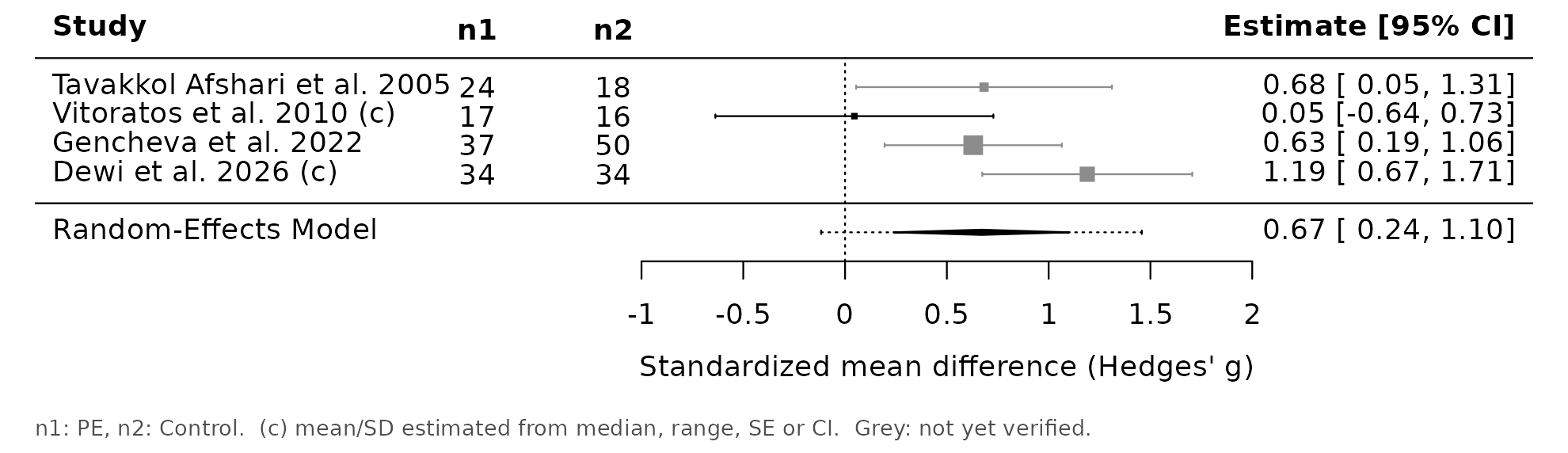
The cumulative meta-analysis shows how the pooled estimate evolved as studies were published, the essence of a living review:
plot_cumulative(ma)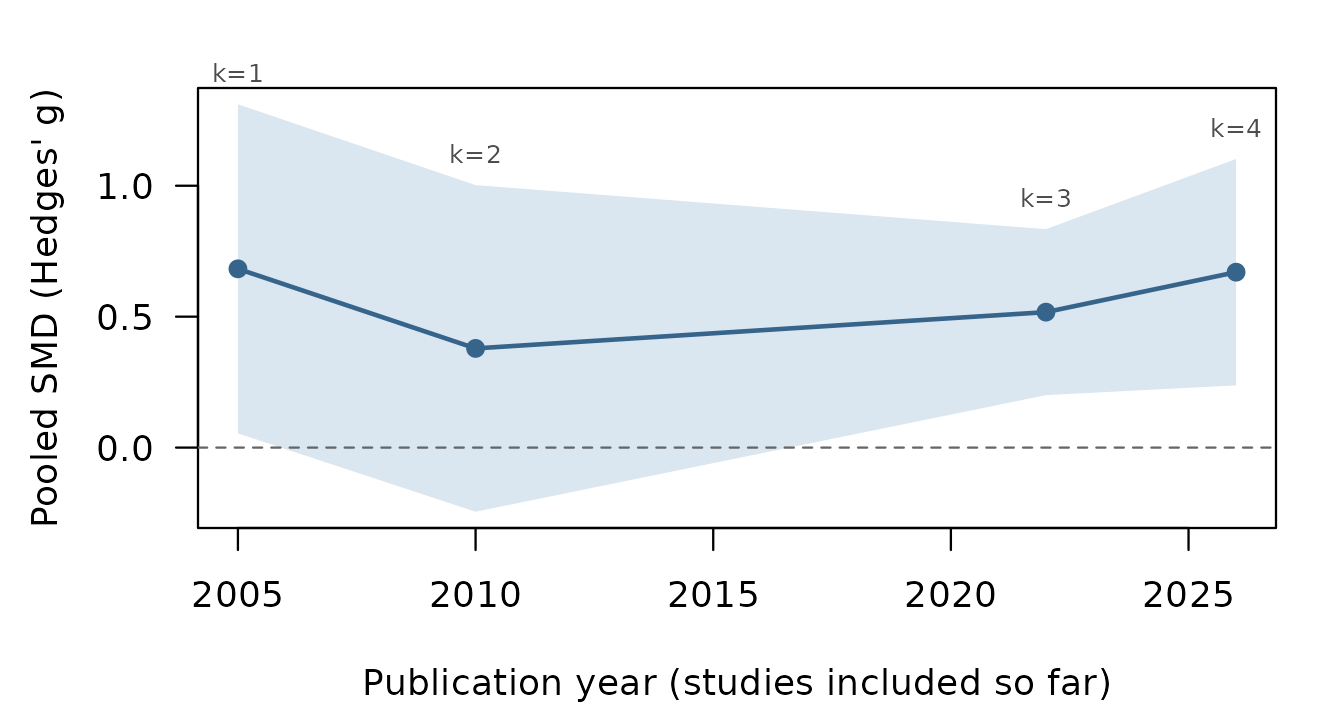
With four small, heterogeneous studies, the estimate is uncertain (the prediction interval includes zero), as it should be for an example this size.
Apples to apples: one level per study
Every analysis states the level it compares, and each study
contributes exactly one set of participants per arm.
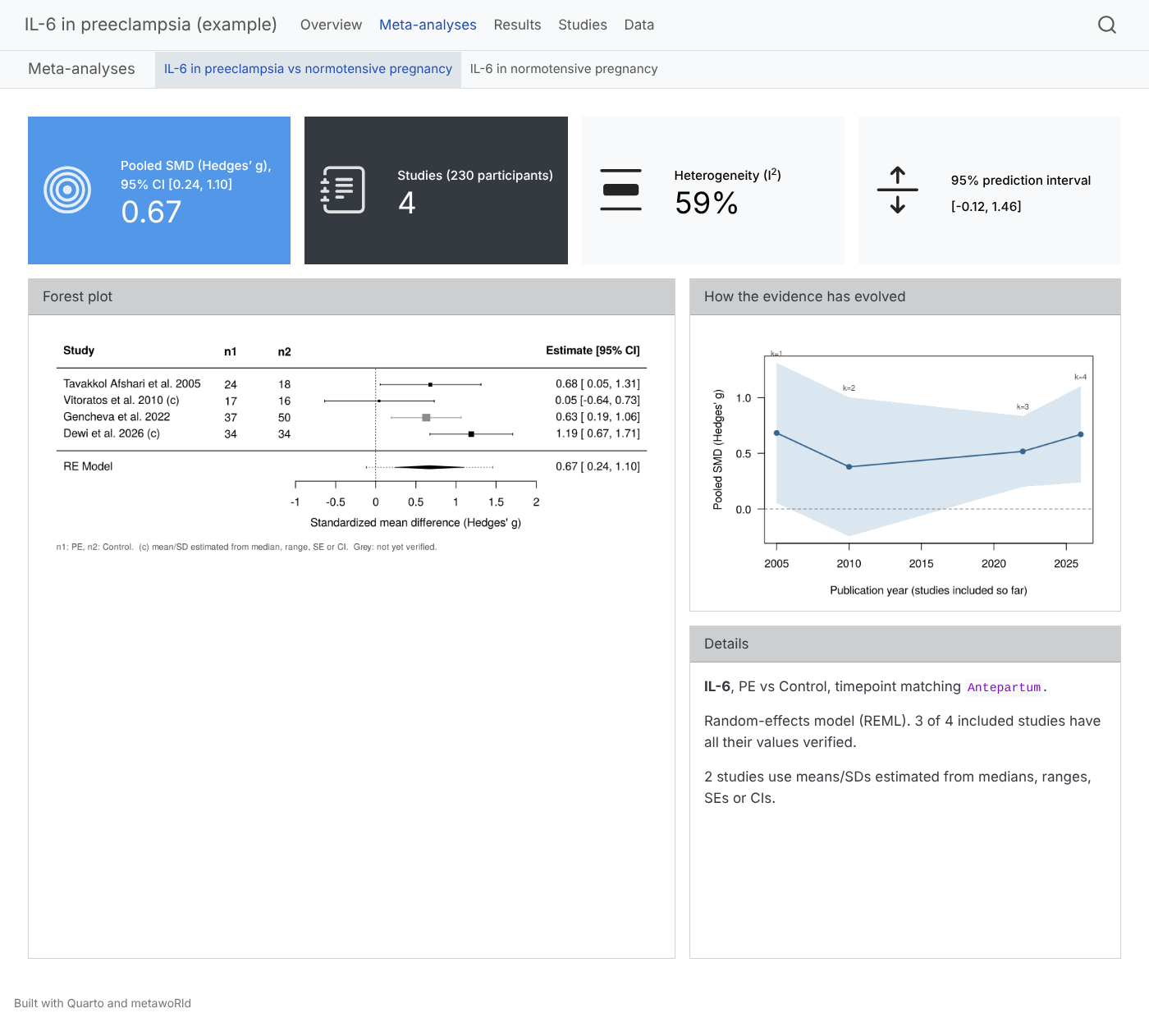
selection (also shown on the dashboard) records which
groups each study contributed and how:
ma$selection[, c("study_id", "arm", "group_names", "how", "n")]
#> # A tibble: 8 × 5
#>   study_id      arm     group_names               how          n
#>   <chr>         <chr>   <chr>                     <chr>    <dbl>
#> 1 afshari2005   PE      Preeclampsia              reported    24
#> 2 afshari2005   Control Normal pregnant           reported    18
#> 3 dewi2026      PE      Preeclampsia              reported    34
#> 4 dewi2026      Control Normotensive pregnancy    reported    34
#> 5 gencheva2022  PE      Pre-eclampsia             reported    37
#> 6 gencheva2022  Control Healthy pregnant controls reported    50
#> 7 vitoratos2010 PE      Preeclampsia              reported    17
#> 8 vitoratos2010 Control Normotensive controls     reported    16
Gencheva contributes its reported preeclampsia total (n = 37), not
the total plus its subgroups. As a sensitivity analysis,
levels: pool uses the subgroups pooled instead; here that
gives the same numbers, because they reproduce the total:
a <- read_analyses(path)[[1]]
pooled <- run_meta_analysis(path, modifyList(a, list(name = "Subgroups pooled", levels = "pool")))
pooled$selection[pooled$selection$study_id == "gencheva2022", c("arm", "how", "n")]
#> # A tibble: 2 × 3
#>   arm     how                                       n
#>   <chr>   <chr>                                 <dbl>
#> 1 PE      pooled subgroups (pe_early + pe_late)    37
#> 2 Control reported                                 50
pooled$summary$estimate == ma$summary$estimate
#> [1] TRUE
A subgroup analysis compares the subgroups instead. Each study contributes one row per subgroup it reports; the 50 controls shared by Gencheva’s two subgroups are split 25/25, so no control is counted twice. Only one study reports onset here, so this only illustrates the mechanics:
by_onset <- run_meta_analysis(path, modifyList(a, list(name = "IL-6 by onset", subgroups = c("PE_early", "PE_late"))))
by_onset$data[, c("label", "n1", "n2", "note")]
#> # A tibble: 2 × 4
#>   label                              n1    n2 note
#>   <chr>                           <dbl> <dbl> <chr>
#> 1 Gencheva et al. 2022 [PE_early]    31    25 Control group shared by 2 subgroups: its n is split 2…
#> 2 Gencheva et al. 2022 [PE_late]      6    25 Control group shared by 2 subgroups: its n is split 2…
by_onset$excluded
#> # A tibble: 3 × 2
#>   study_id      reason
#>   <chr>         <chr>
#> 1 afshari2005   no usable data for: PE_early, PE_late
#> 2 dewi2026      no usable data for: PE_early, PE_late
#> 3 vitoratos2010 no usable data for: PE_early, PE_late
9. The dashboard
generate_website() builds a Quarto dashboard that is
rebuilt on every change (use_github_action_quarto()
publishes it on GitHub Pages):

In one call
p <- example_project(file.path(tempdir(), "il6"))
review_values(p)
generate_website(p)
Sources
- Tavakkol Afshari J, Ghomian N, Shameli A, et al. Determination of interleukin-6 and tumor necrosis factor-alpha concentrations in Iranian-Khorasanian patients with preeclampsia. BMC Pregnancy Childbirth 2005;5:14. https://doi.org/10.1186/1471-2393-5-14
- Vitoratos N, Economou E, Iavazzo C, et al. Maternal serum levels of TNF-alpha and IL-6 long after delivery in preeclamptic and normotensive pregnant women. Mediators Inflamm 2010;2010:908649. https://doi.org/10.1155/2010/908649
- Gencheva D, Nikolov F, Uchikova E, et al. Interleukin-6 and its correlations with maternal characteristics and echocardiographic parameters in pre-eclampsia, gestational hypertension and normotensive pregnancy. Cardiovasc J Afr 2022;33(2):65–73. https://pmc.ncbi.nlm.nih.gov/articles/PMC9364472
- Dewi SR, Yeni CM, Munizar M, et al. Comparison of interleukin-6 and serum creatinine levels in preeclampsia and normal pregnancy patients: a cross-sectional study in Indonesia. Narra J 2026;6(1):e3016. https://doi.org/10.52225/narra.v6i1.3016
- Wan X, Wang W, Liu J, Tong T. Estimating the sample mean and standard deviation from the sample size, median, range and/or interquartile range. BMC Med Res Methodol 2014;14:135. https://doi.org/10.1186/1471-2288-14-135